

ATEE 2026 Programme

Invited Sessions

Curated partner-led sessions connecting academic research, educational practice, international cooperation and institutional expertise.

The programme brings together invited institutions, academic networks and conference partners for focused panels, presentations and interactive workshops. Explore the sessions below and use the programme cards to jump directly to full details.

6 partner-led sessions
26 - 28 August 2026 University of Białystok

Invited sessions at a glance

Browse the programme by day and select a session to view its partner, contributors, format and full abstract.

Wednesday, 26 August

Three invited partner sessions

11:30 13:00
UNESCO Room C1.6

The Future of Teacher Education and the Teaching Profession: A Dialogic Exploration with UNESCO

UNESCO Special Session combining a framing presentation with two rounds of interactive dialogue.

11:30 13:00
CRNEM, University of Białystok Room C02

Education of National and Ethnic Minorities as a Space for Crossing Borders

Moderated panel discussion on minority education in Poland.

17:00 18:30
EFIL and AFS Poland Room C2.3

All About Connections: International Collaboration among Teachers and the Role of Student Exchanges

Policy, research and practice perspectives with audience engagement.

Thursday, 27 August

Two invited partner sessions

09:00 10:30
BlueLightS Project and EMSEA Room A105

Bringing Ocean and River Sustainability to the Classroom

Interactive workshop with practical resources and Blue Challenge examples.

09:00 10:30
Echo360 Room C02

Recording Teaching Practice with GoReact to Build Professional Judgement

Interactive demonstration focused on video-supported reflection and feedback.

Friday, 28 August

One invited partner session

11:15 12:45
MONEUL Project Consortium Room C2.19

Teaching and Learning about the European Union in Mongolia

Inclusion, internationalisation and teacher education in critical times.

Invited Partner Session 1

Education of National and Ethnic Minorities as a Space for Crossing Borders

Centre for Research on National and Ethnic Minorities, University of Białystok
26 August 2026 11:30 - 13:00 Room C02

Abstract

This invited panel examines minority education as a space in which cultural, linguistic and institutional borders can be questioned and crossed. Representatives of the Belarusian, Lithuanian and Ukrainian minorities in Poland, all actively involved in education and minority schooling, will discuss the current situation of national minority education in the Republic of Poland.

The conversation will focus on the challenges faced by minority schools and educational communities, including the preservation of language and cultural identity, access to appropriate educational provision, the preparation and availability of teachers, and relationships between minority communities and public institutions. Particular attention will be given to stereotypes and misconceptions surrounding minority education and to ways in which schools can challenge them.

Drawing on the panellists' professional and community experience, the session will show how minority education can support intercultural understanding, strengthen social participation and create meaningful connections across linguistic, cultural and social boundaries. The panel will conclude with questions and discussion with the audience.

Session format

Moderated panel discussion involving representatives of national minorities actively engaged in education and minority schooling, followed by audience questions and discussion.

Language and interpretation The panel will be conducted in Polish, with simultaneous interpretation into English provided throughout the session.
Invited Partner Session 2

The Future of Teacher Education and the Teaching Profession: A Dialogic Exploration with UNESCO

UNESCO Special Session at the ATEE Conference

26 August 2026 11:30 - 13:00 Room C1.6

Rationale

Teachers remain central to the realization of quality education for all, yet their roles, working conditions, and professional identities are being reshaped by profound changes that cut across traditional borders. Teacher shortages, digital transformation, climate and conflict crises, changing learner needs, and more, raise new questions about the knowledges, skills, dispositions, and careers expected of teachers.

Perspectives from teacher educators - those intimately involved in preparing teachers - are essential to understanding and addressing these questions. As inherent border-crossers, teacher educators and their institutions occupy a strategic position between research, policy, and practice, offering vital insights into the changing natures of teaching and teacher education.

This UNESCO Special Session provides a unique opportunity to engage in an active and structured dialogue on the futures of teaching and teacher education. A brief presentation by UNESCO will frame the session, then participants will have an opportunity to discuss five key, cross-cutting areas:

1
Policy
2
Pedagogy and practice
3
Research and knowledge production
4
Professionalism and the profession
5
Coordination and collaboration

The goal of the session is to collectively envisage new pathways for promoting, protecting, and advancing teaching and teacher education in the years to come.

Objectives

The consultation aims to:

1
Gather the perspectives of ATEE participants on the major trends, risks, and opportunities shaping the future of teacher education and the teaching profession.
2
Identify priority messages and strategies to inform the education agenda on teachers, teacher educators, teacher education, professional learning, and workforce development.
3
Explore how teacher educators, teacher education institutions, and schools/faculties of education can contribute to more equitable, inclusive, resilient, humanistic, and future-oriented education systems.

Session format

The session is designed as a 90-minute session that includes a brief presentation and two rounds of interactive dialogues.

Language EN

Draft agenda

A 90-minute sequence moving from framing and orientation to collaborative dialogue, development and plenary synthesis.

5 mins
Introduction

Welcome and objectives of the session

20 mins
Framing Presentation

UNESCO's Work on Teachers, Teaching, and Teacher Education: Past, Present, and Future

5 mins
Facilitation Instructions and Transition
25 mins
Jigsaw Group #1 - Discussion Groups

What ideas and strategies can be advanced to support healthy futures?

1 Policy
2 Pedagogy and practice
3 Research and knowledge production
4 Professionalism and the profession
5 Coordination and collaboration
5 mins
Facilitation Instructions and Transition
25 mins
Jigsaw Group #2 - Development Groups

How can these ideas and strategies be further developed across thematic, geographical, and organizational borders?

5 mins
Plenary restitution

Priority messages and areas of convergence

Invited Partner Session 3

All About Connections: International Collaboration among Teachers and the Role of Student Exchanges

European Federation for Intercultural Learning and AFS Poland

26 August 2026 17:00 - 18:30 Room C2.3

Abstract

This invited session explores the connections between international collaboration among teachers, student exchanges and the wider internationalisation of school education. Elisa Briga will introduce the European Education Area and relevant EU priorities, outlining different forms of school internationalisation and highlighting why future and practising teachers should be prepared to engage with them.

James Underwood will present insights into the processes, conditions and professional learning involved in international collaboration among teachers. Dorota Kuipers will examine how educational exchange organisations contribute to the internationalisation of secondary schools and support teachers in promoting active global citizenship, drawing on examples from AFS Poland and teachers' experiences. Elisabeth Hinshaw-Osgood will discuss the role of liaison and contact persons in supporting exchange students, teachers and host schools, as well as opportunities for further teacher learning.

The interventions will be connected through a shared focus on how partnerships between teachers, schools and out-of-school education providers can turn international mobility into meaningful professional and educational development. The session will conclude with interactive audience questions and an open discussion.

Session format

Interconnected interventions combining policy, research and practice, followed by audience engagement through Mentimeter and an open Q&A discussion.

Visit the European Federation for Intercultural Learning website
Invited Partner Session 4

Bringing Ocean and River Sustainability to the Classroom

BlueLightS Project and European Marine Science Educators Association

27 August 2026 09:00 - 10:30 Room A105

Abstract

The continuing degradation of aquatic ecosystems has led the European Union to make the restoration of oceans, seas and inland waters by 2030 one of its major EU Missions. This workshop presents how the BlueLightS project supports the integration of ocean and river sustainability into education systems and schools, while contributing to the Network of European Blue Schools.

The facilitators will discuss approaches to embedding aquatic sustainability in national education strategies, curricula, teaching resources and teacher professional development. Drawing on examples of Blue Challenge projects implemented by schools across Europe, the session will demonstrate how teachers can bring ocean and river topics into their classrooms through interdisciplinary, locally relevant and action-oriented learning.

Participants will be invited to consider the challenges teachers encounter when introducing these issues and to identify practical ways of addressing them. The workshop will also introduce resources developed by BlueLightS, including financial support for school projects, an e-learning tool designed to strengthen teachers' ocean literacy, and a digital platform offering pedagogical resources, webinars and opportunities for professional exchange.

Session format

Interactive workshop combining a project presentation, examples of school-based Blue Challenges, demonstration of teaching resources and facilitated discussion with participants.

Learn more about the BlueLightS Project
Invited Partner Session 5

Recording Teaching Practice with GoReact to Build Professional Judgement

Echo360

27 August 2026 09:00 - 10:30 Room C02

Abstract

Teaching practice is most powerful when it can be revisited, reflected upon and discussed with evidence. This interactive workshop explores how GoReact enables teacher educators to capture teaching practice on video, transforming feedback into a meaningful process of professional growth.

Participants will discover how recorded teaching creates opportunities for trainees, mentors and assessors to revisit key moments, connect feedback directly to observable practice and make informed professional judgements about progress, impact and next steps. The session will demonstrate how GoReact supports flexible observation and assessment, enabling teaching practice to be reviewed anytime, from anywhere, while maintaining consistency and rigour.

Through practical examples and discussion, attendees will explore how video-supported reflection strengthens self-awareness, builds confidence and helps educators develop targeted teaching skills over time. The workshop will also showcase how GoReact facilitates timely, evidence-based feedback that is specific, actionable and grounded in authentic classroom practice.

Ideal for teacher educators, mentors and programme leaders, this session will provide practical strategies for enhancing teacher development, improving assessment quality and supporting continuous professional learning.

Session format

Interactive workshop with demonstration, discussion and Q&A.

Invited Partner Session 6

Teaching and Learning about the European Union in Mongolia: Inclusion, Internationalisation and Teacher Education in Critical Times

MONEUL Project Consortium

28 August 2026 11:15 - 12:45 Room C2.19
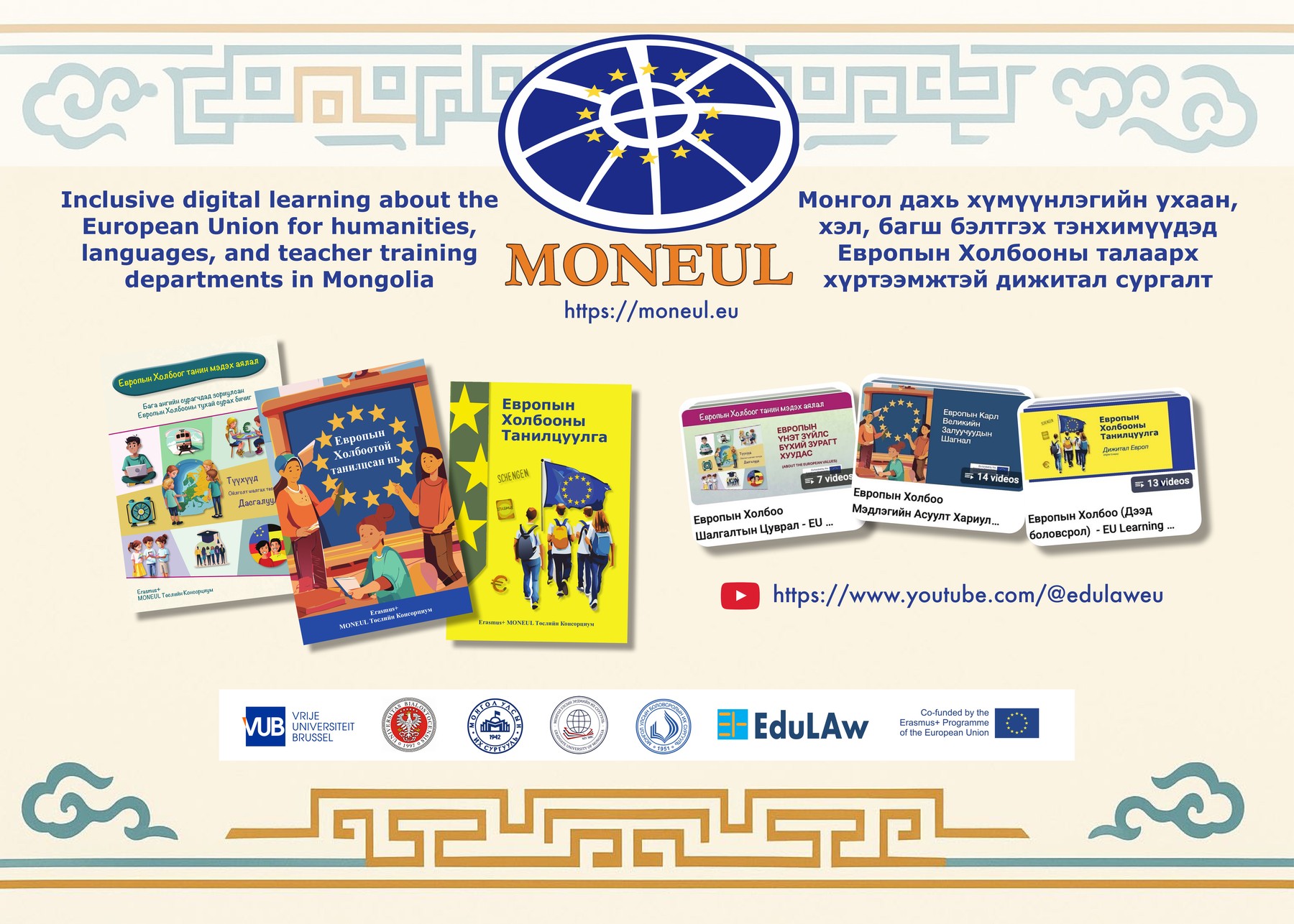
MONEUL project banner presenting inclusive digital learning about the European Union in Mongolia Visit the MONEUL project website

Abstract

This invited session presents the results and experiences of the MONEUL project, led by Professor Gracienne Lauwers. The project supports inclusive digital learning about the European Union within Humanities, Languages and Teacher Training departments at Mongolian partner universities. Bringing together institutions from Mongolia, Belgium and Poland, as well as a European association, MONEUL contributes to capacity building and the internationalisation of higher education in Mongolia.

The panellists will examine the project from three complementary perspectives. Tsagaanchuluun Norov will discuss inclusive education in Mongolia, focusing on teachers' perspectives and learning from European Union experience. Aldarmaa Tundevrentsen will reflect on the process of implementing MONEUL at the Graduate University of Mongolia and its contribution to institutional internationalisation. Izabela Kraśnicka and Wojciech Zoń will address the challenges of teaching European Union law in times of political, social and institutional uncertainty.

Together, the presentations will highlight the development of digital modules, inclusive course design, modernised teaching resources and new approaches to increasing knowledge and visibility of the European Union in Mongolia.

Session format

Interconnected project presentations followed by a moderated discussion and audience Q&A.

Visit the MONEUL project website

Detailed Agenda & Activities

Ready to dive deeper? Navigate through the sections below to find the daily schedule, read about our keynote speakers, explore workshop details, and see what cultural tours await you.

As part of our website, we use cookies stored on the user's device in order to adapt the behavior of the website to the individual preferences of the user and for statistical purposes. The user has the option to change the cookie settings in their web browser. More information can be found in the Privacy Policy. By using the website, you consent to the use of cookies, in accordance with the browser settings.